Fellow Spotlight: The Power of Storytelling in Healthcare
January 28, 2026 2026-01-28 18:55Fellow Spotlight: The Power of Storytelling in Healthcare
By: Javacia Harris Bowser
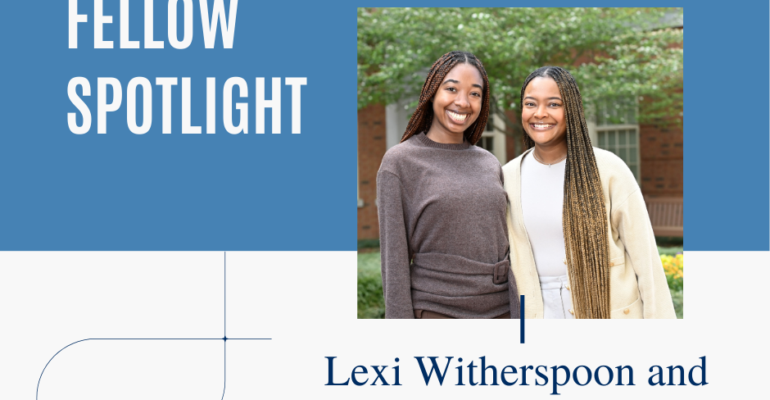
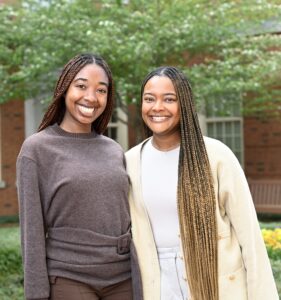
For years, Mykala Walker considered her love of documentaries and passion for storytelling a hobby. But as a student at the University of Alabama at Birmingham Heersink School of Medicine and School of Public Health, she began to explore how storytelling could be used to advocate for patients and teach patients to advocate for themselves. After she met and befriended Lexi Witherspoon, also a student at UAB Heersink School of Medicine, and learned about the Albert Schweitzer Fellowship, she approached Lexi about applying for the program to do a project combining storytelling and health care.
In a stroke of serendipity, Lexi shared that she’d participated in a summer program at Columbia University centered on Narrative Medicine.
“It was meant to be,” Mykala said.
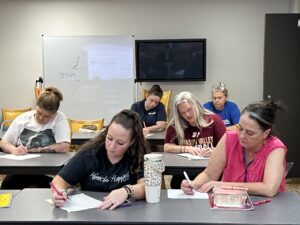
For their ASF project, Mykala and Lexi are working with the women of The Lovelady Center, who have been impacted by incarceration or substance abuse disorder. Through art and discussion prompts, the women are gaining the skills to understand how their story has affected their health and healthcare and learning to be better advocates for themselves in the healthcare system and beyond.
“If we give the women the capability to analyze their own story, they can better advocate for their stories and articulate it and challenge the narratives that are already set out about different stigmatized groups,” Mykala said.
But Narrative Medicine is also about healthcare providers using storytelling to become more compassionate caregivers.
“Our biggest thing is trying to figure out how we can best serve our classmates and future clinicians by showing them patients are all people at the end of the day,” Lexi said. “We really wanted to highlight stories and how when you come to the doctor, you’re more than just what your symptoms are or what disease you have. You are a person.”
What is Narrative Medicine?
Narrative medicine is an interdisciplinary approach to healthcare that draws on the tools and methods of literary analysis and art interpretation to help healthcare providers understand the patient’s narrative and its significance for their care.
With Narrative Medicine, healthcare providers engage a work of art – such as a painting, a poem, or a short story – and reflect on the piece with the help of specific prompts.
“Doing these exercises improves analysis and listening capabilities, and hopefully that will improve the healthcare provider’s skills in those areas when they’re also seeing patients,” Mykala explained.
For their ASF project, Mykala and Lexi led six-week courses at The Lovelady Center. Each week of the class, participants examined a piece of art by an artist
who is part of a stigmatized or marginalized group.
They’ve read “Girl” by Jamaica Kincaid to reflect on her depiction of being both a Black woman and an immigrant. They’ve read excerpts from “The Things They Carried” by Tim O’Brien, to reflect on the difficulties veterans face. They’ve examined self-portraits of Frida Kahlo and discussed the lives of Hispanic and Indigenous people.
“We’re trying to show them how they reclaimed their story,” Mykala said. And the women are asked to ponder questions such as “What can we learn from this? What parallels do you see in your life?”
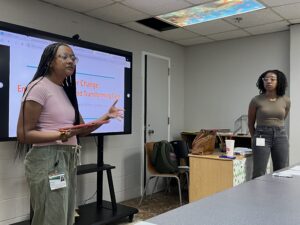 At the culmination of the six weeks, the women are asked to create their own work of art in any medium they choose. Some women have written poems. Some have written short stories. One participant performed a rap song. Some participants have enjoyed the course so much they’ve taken it twice and invited friends to join.
“We’ve heard a lot of good feedback,” Lexi said.
Mykala and Lexi have also hosted a Narrative Medicine workshop for third-year medical students at UAB.
“After talking with admin about how we can integrate it to educate the students on this topic, it was advised that it would be good to do third year, since that’s when they’re actually in their clinical rotation of seeing patients,” Mykala explained.
They’re hoping to help create a Narrative Medicine course at UAB that will give students the chance to work with the women at The Lovelady Center so that both medical students and the women of The Lovelady Center can continue to learn about the power of storytelling.