Fellow Spotlight: Sight, Sound, and Quality of Life
March 3, 2026 2026-03-03 3:49Fellow Spotlight: Sight, Sound, and Quality of Life
By Javacia Harris Bowser
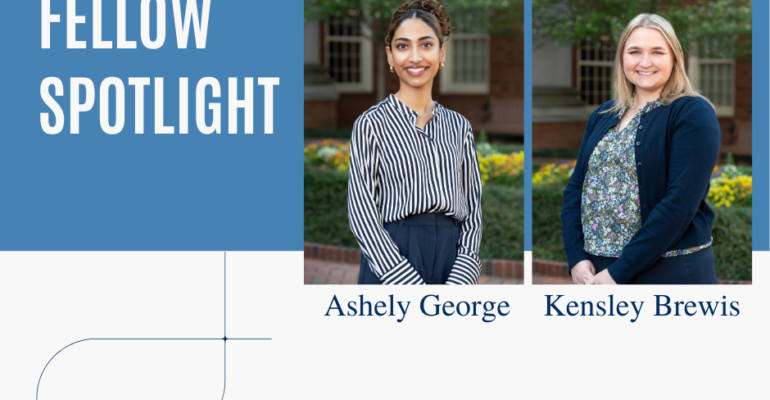
Hearing and vision loss can profoundly affect a person’s overall health, often leading to social isolation, depression, reduced independence, and even an increased risk of cognitive decline. Fellows Ashley George and Kensley Brewis of the Albert Schweitzer Fellowship of Alabama are working to combat these challenges and improve the quality of life for those most affected.
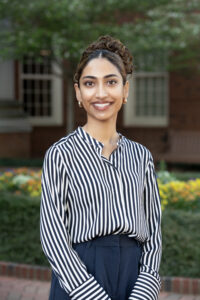
Ashely George
Ashely George wants all people – regardless of where they live or how much money they make – to get the eye care that they need. It was during her time in undergrad, volunteering at a clinic for low-income patients, that she discovered her passion for optometry and for helping the underserved. Today, as a student in both the University of Alabama at Birmingham’s School of Public Health and School of Optometry, she’s finding a way to pursue her passions and make an impact.
For her ASF project, she’s developed an optometry protocol and a series of educational videos for the Community of Hope Health Clinic’s mobile unit.
“Many live in eye care deserts or lack transportation to providers, leading to undiagnosed and untreated vision conditions,” she said. “Oftentimes, people don’t have the resources to get to us, so since we have the resources, we might as well go to them.”
CHHC’s mobile unit travels to underserved rural communities to offer a variety of health screenings. With the protocol Ashely developed, this also includes vision screenings.
“By bringing eye care directly to these communities, I hope to reduce preventable blindness and enhance overall quality of life,” she said.
She’s also creating a series of short, educational videos to inform patients how conditions such as diabetes and hypertension can impact eye health. The videos will also be translated into Spanish.
But Ashely shared that her ASF experience has been educational for her as well. She’s helped several patients get the eye care they needed, but when a patient with a severe vision impairment refused treatment, Ashely was disheartened.
“A really big part of me felt like I wasn’t doing enough,” she said. “But I came to realize that there’s a lot more that patients have to deal with.” Patients, for example, could be healing from trauma or past bad experiences with health care providers. Life circumstances could also make them resistant to receiving care.
“There’s so much going on that we as outsiders will not understand,” she said. But Ashely believes this experience will add more depth and more understanding to her interactions with patients in the future.
When Ashely’s fellowship year comes to an end, her work will live on. A medical student has been shadowing her and will continue her work. Furthermore, future volunteers at the clinic will learn her optometry protocol and the CHHC will have her informational videos to share with patients.
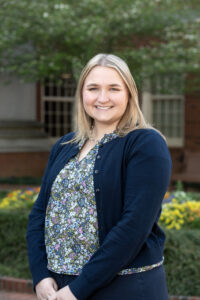 Kensley Brewis
Kensley Brewis, a doctoral student in Audiology at Auburn University, has seen firsthand how untreated hearing loss can lead to social isolation, cognitive decline, and reduced quality of life. That’s why for her Albert Schweitzer Fellowship project, Kensley partnered with the Chambers County Community Health and Wellness Center to create an aural rehabilitation group for older adults with hearing loss.
“I aim to empower individuals with communication strategies and social support, ultimately improving their well-being,” Kensley said.
She’s also helped a few participants with impaired hearing who couldn’t afford hearing aids get the devices that they needed.
Through Kensley’s project, participants have learned the basics of hearing healthcare and hearing technology, including causes of hearing loss, how hearing aids work to help those with hearing loss, and how to properly take care of hearing aids.
Part of the nine-lesson curriculum that Kensley created for her project also addresses the connection between hearing and cognition.
“People have used it as a scare tactic, saying if you have hearing loss and you don’t buy hearing aids, you’re going to get dementia, which is not true,” Kensley says. “It’s not guaranteed.”
However, there is a link between hearing and cognition, and during her lessons with program participants, she seeks to demystify that connection.
She also uses this unit to help participants have some fun.
To test both hearing and long-term memory, participants play a game Kensley calls “Singo Bingo.” Think “Name That Tune” but make it Bingo.
For another lesson, participants take a field trip. They go out into the community as Kensley demonstrates how different environments can shift aural needs.
Participants learn communication strategies, too. Kensley gives a few examples: “Facing your communication partner and trying to be in a well-lit room so you can read lips if you need to, putting noise behind you so you’re less affected by it, having the person you’re talking to say your name before they speak.”
For the communication unit, participants are encouraged to invite a family member.
“We don’t want it to feel like it’s all on the patient because it’s not,” Kensley said. “Communication goes both ways.”
After Kensley’s fellowship year ends, the aural rehabilitation group program she’s developed will continue as the project will be assigned to other students in Auburn’s Doctor of Audiology program.
While Kensley hasn’t decided what her specialty within audiology will be, she believes her ASF experience will help her no matter what she chooses.
“It’s helping me prepare in lots of ways in terms of counseling and education,” she said. “I feel like that’s an aspect of our field that sometimes gets overlooked.”